Alaska Migratory Birds Regulations Overview
General Overview
This booklet is an informative summary of the 2026 Alaska subsistence spring/summer migratory bird harvest regulations contained in Title 50 Code of Federal Regulations (CFR) Part 92. There may be errors or omissions that have not been identified and regulatory changes that occur after printing. This booklet is intended as an informational guide only. To be certain of current regulations, refer to the official CFR.
These regulations apply to the spring and summer subsistence harvest of migratory birds in Alaska, April 2 through August 31, 2026. The Council reviews and recommends needed modifications to these regulations annually.
Migratory bird hunting from September 1, 2026 through March 10, 2027 is managed under separate Federal regulations in Title 50 CFR Part 20 and State regulations in 5 AAC 85.065.
To submit a regulation proposal for spring/summer subsistence harvest of migratory birds please visit https://www.fws.gov/node/269366.
The Alaska Migratory Bird Co-Management Council (Council) will review and recommend needed modifications of these harvest regulations on an annual basis, working within the schedule of the Federal late season migratory bird hunting regulations process.
Migratory Bird Regulation Changes
This is not a comprehensive list of all the detailed changes. It is your responsibility to read the regulations carefully for complete information. The most up-to-date information can be obtained by contacting your regional co-management council representative (found here), or by reviewing the complete set of regulations in the CFR (link).
The Upper Copper River region is now named 'Ahtna Territory' and the season and closure dates are uniform throughout the region.
Legislative History
As early as 1916, Migratory Bird Treaties with Canada and Mexico failed to recognize Alaska’s traditional spring/summer subsistence harvest.
After negotiations, the treaties were amended in 1997. The Alaska Migratory Bird Co-Management Council was created, which included representatives from the Alaska Native community, the Alaska Department of Fish and Game, and the U.S. Fish and Wildlife Service acting as equal partners. The Council’s primary purpose is to develop recommendations for the subsistence migratory bird harvest regulations.
Eleven regional management bodies were created to provide local input to the Council on the bird harvest list, regional season dates, methods and means and other annual regulatory recommendations. Additional information on the Migratory Bird Treaties, the Council, harvest surveys, press releases and hunter bulletins can be found at
https://alaskamigratorybirds.com/ and https://www.fws.gov/office/alaska-migratory-birds/alaska-migratory-bird- co-management-council
Who is Eligible to Participate?
If you are a permanent resident (see Definitions) of a village within an included subsistence harvest area, you are eligible to harvest migratory birds and eggs for subsistence purposes.
-
Village areas located within:
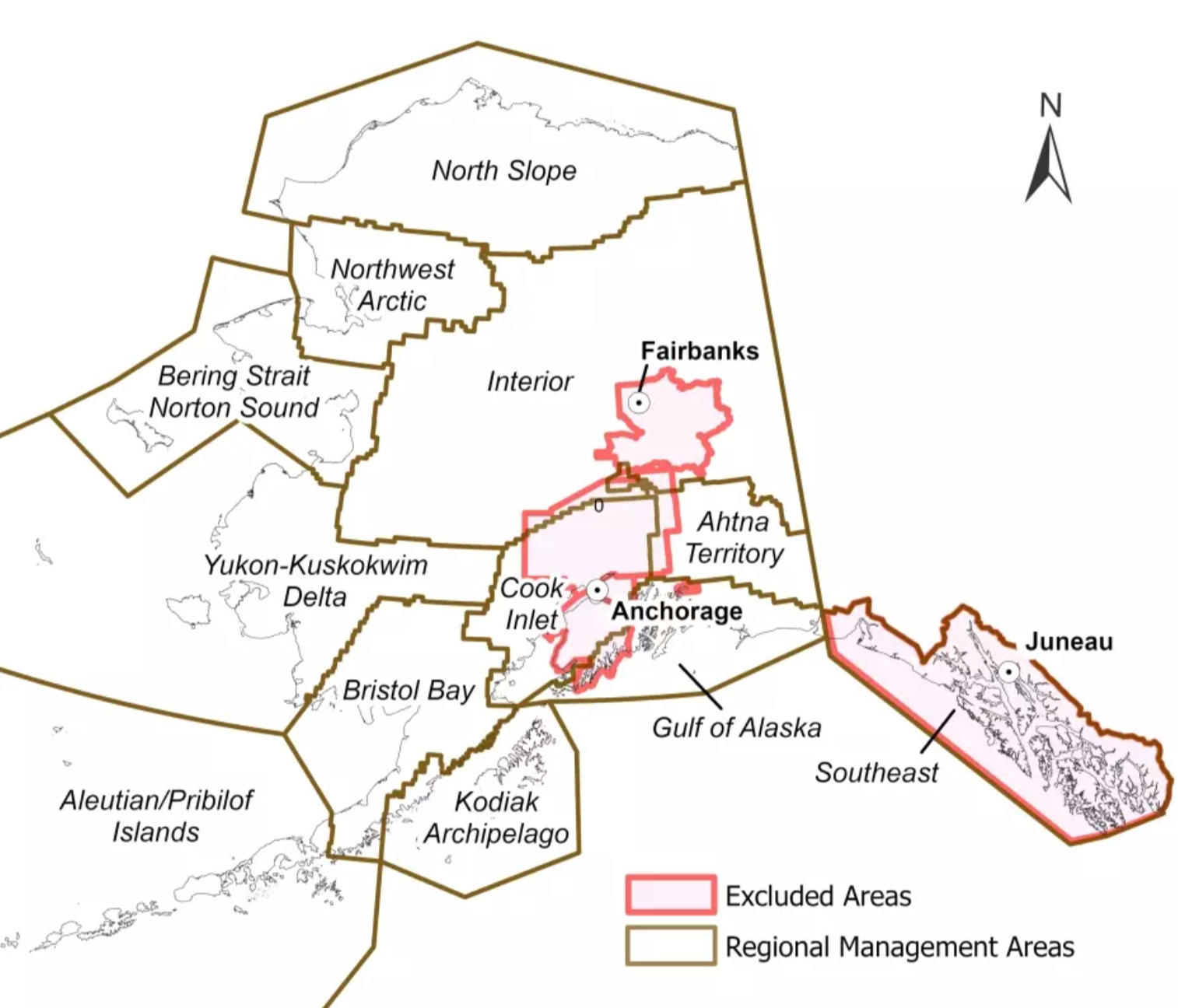
The Alaska Peninsula/Bristol Bay, Kodiak Archipelago, the Aleutian Islands, or areas north and west of the Alaska Range are subsistence harvest areas.
Additional included communities added by petition are:
Gulkana
Gakona
Tazlina
Copper Center
Mentasta Lake
Chitina
Chistochina
Tatitlek
Chenega
Port Graham
Nanwalek
Tyonek
Hoonah
Craig
Hydaburg
Yakutat
Cordova.
-
Village areas located in Anchorage, Matanuska-Susitna Borough, Central Interior Excluded area, or the Kenai Peninsula roaded area. In the Gulf of Alaska, Copper River Region, Cook Inlet or Southeast Alaska, only residents of the previously listed communities can participate in the harvest.
Anyone can petition the Council to change a community's exclusion/inclusion status. The petition must address how the area does or does not meet the qualifying criteria for inclusion. Upon receipt, the Council will seek regional input and then submit a recommendation to the U.S. Fish & Wildlife Service to either include or exclude the community from the subsistence harvest.
-
Permanent resident means any person whose primary, permanent home for the previous 12 months was within a subsistence harvest area in Alaska. Whenever absent from this primary, permanent home, the person has the intention of returning to it.
-
Immediate family members who are residents of excluded areas may participate in the customary spring and summer subsistence harvest in a community’s subsistence area with permission of the Village or Tribal council, whichever is appropriate, to assist indigenous inhabitants in meeting their nutritional and other essential needs or for the teaching of cultural knowledge. A letter of invitation will be sent by the Village or Tribal council to the hunter with a copy to the Executive Director of the Co-management Council.
In the Upper Copper River region, an invitation permit may be issued from the Tribal Council to the hunter with a copy to the Executive Director of the Co-management Council as an alternative to the letter of invitation.
-
Indigenous inhabitant means a permanent resident of a village within a subsistence harvest area, regardless of race.
Image of excluded & included subsistence harvest areas for
Special Requirements for National Park Service Lands
Subsistence use on National Park Service areas is restricted to only those national monuments, parks, and preserves open to subsistence. Glacier Bay National Park, Katmai National Park, Kenai Fjords National Park, Klondike Gold Rush National Historical Park, “old” McKinley National Park and Sitka National Historical Park are closed to subsistence. National Park Service regulations govern which communities or individual residents qualify to subsistence harvest for specific National Parksand Monuments (50 CFR Part 13, Subparts A, B, and C).
For more information about National Park Service areas contact:
National Park Service, 240 West 5th Ave., Room 114, Anchorage, AK 99501, (907) 644-3509.
Use and Possession of Migratory Birds
You may not sell, offer for sale, purchase, or offer to purchase migratory birds, their parts, or their eggs taken under these regulations, except as provided in this section.
-
Giving and receiving migratory birds. Under these regulations, you may take migratory birds for human consumption only. Harvest and possession of migratory birds must be conducted using nonwasteful taking. Edible meat of migratory birds may be given to immediate family members by eligible persons. Inedible byproducts of migratory birds taken for food may be used for other purposes, except that taxidermy is prohibited, and these byproducts may only be given to other eligible persons or Alaska Natives.
Authentic native articles of handicraft or clothing (see page 34).
-
Eligible persons - You may take birds for human consumption only. Harvest and possession of migratory birds must be done using non-wasteful taking. Non-edible byproducts of birds taken for food may be used for other purposes, except that taxidermy is not allowed.
-
Non-eligible persons - You may receive portions of birds or their eggs not kept for human consumption from eligible persons only if you have a valid U.S. Fish & Wildlife Service permit for scientific research or education.
Required Licenses and Stamp
Federal Duck Stamps are not required to participate in this harvest.
Waterfowl hunters 18 years or older are required to have a State hunting license and State Duck Stamp, except disabled veterans, those 60 years or older, and those that qualify for a low-income license.
State stamps and hunting licenses are available from State license vendors, ADF&G offices or online at: http://www.adfg.alaska.gov/ store/
State Duck Stamps must be signed in ink across the face and must be carried at all times while hunting waterfowl.
Shooting Hours
The harvest is open 24-hours per day.
Seasonal Closures
Seasonal closures apply to both bird and egg harvest in Alaska, unless specified otherwise.
Prohibited Harvest Methods and Means
You may not use the following devices and methods to harvest migratory birds:
Swivel guns, shotguns larger than 10 gauge; punt, battery or machine guns, fish hooks, poisons, drugs, explosives, or stupefying substances.
Shooting from a sinkbox or low-floating device that conceals the hunter beneath the surface of the water.
Hunting from any type of aircraft.
Hunting with the aid of recorded bird calls.
Using live birds as decoys, except for auklets on Diomede and St. Lawrence Islands.
Using any vehicle, aircraft, or boat to concentrate, drive, rally, or stir up any migratory birds; however, boats may be used to position a hunter.
Possession or use of lead or other toxic shot while hunting.
Shooting from or across any road or highway.
Using an air boat (Interior and Bristol Bay Regions only) or jet ski (Interior Region only) for hunting or transporting hunters.
Using private or chartered aircraft for hunting or transporting hunters, except for transportation between public airstrips (Yukon/ Kuskokwim Delta Region only).
Hunting with the aid of baiting, or over any baited area, where a person knows or reasonably should know that the area has been baited.
Hunting from motorized vehicles or any form of watercraft (Prince William Sound Area East in Gulf of Alaska Region only).
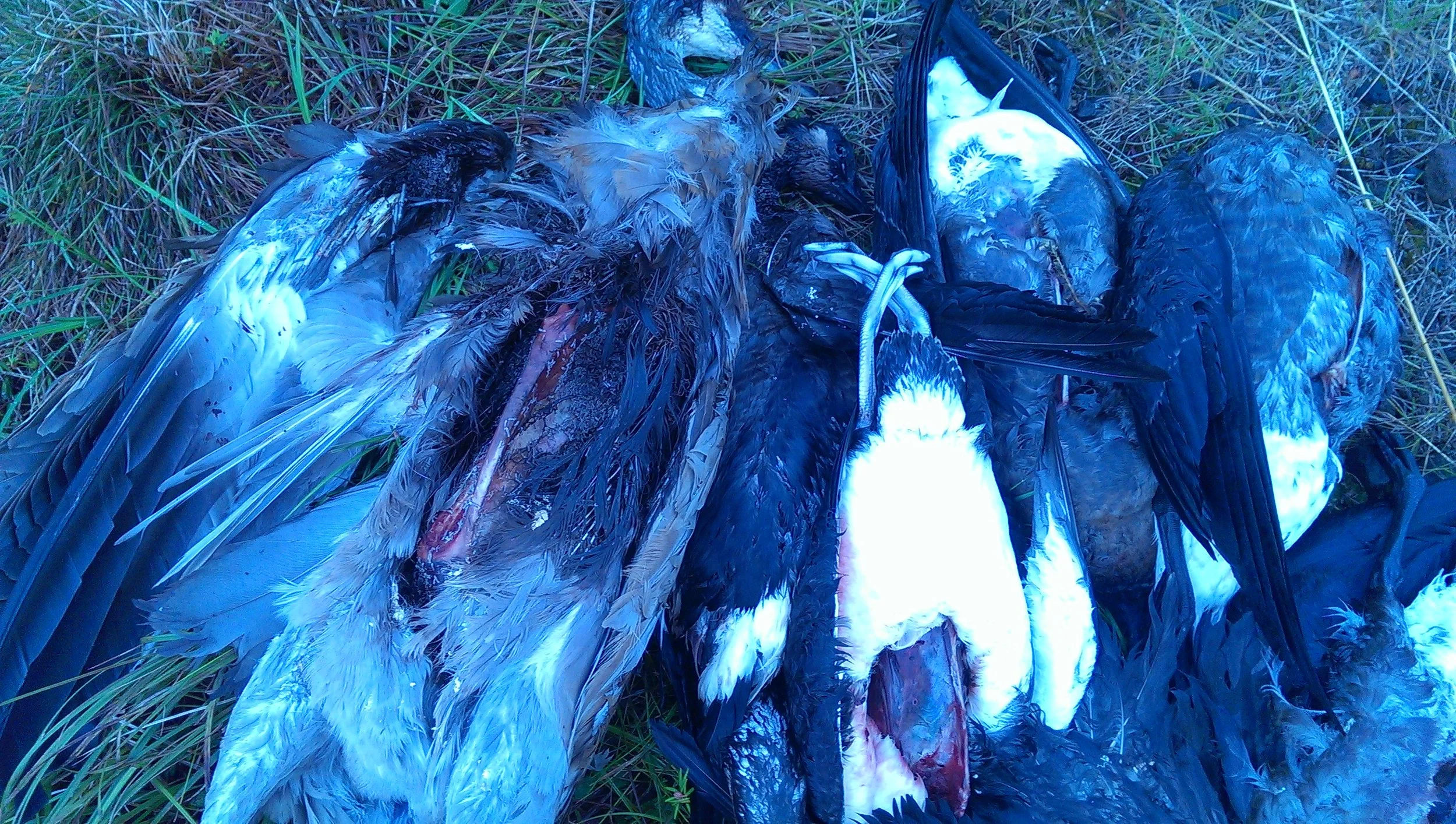
Example of wanton waste
Definitions Used In Regulations
-
Alaska Native means the same as “Native,” defined in section 3(b) of the Alaska Native Claims Settlement Act, 16 U.S.C. 1602(b).
-
Authentic Native article of handicraft or clothing means any item created by an Alaska Native to which inedible parts of migratory birds authorized for use in handicrafts or clothing are incorporated and which is fashioned by hand, or with limited use of machines, provided no mass production occurs.
-
Co-management Council means the Alaska Migratory Bird Co-management Council, consisting of Alaska Native, Federal, and State of Alaska representatives as equals.
-
Closures mean the season is closed to all forms of harvest including hunting and egg gathering, unless specified otherwise.
-
Eligible person means an individual within the State of Alaska who qualifies to harvest migratory birds and their eggs for subsistence purposes during the spring and summer.
-
Edible meat means the meat from the breast, back, thighs, legs, wings, gizzard, and heart.
The head, neck, feet, other internal organs, and skin are considered inedible byproducts, and not edible meat, for all provisions of these regulations.
-
Excluded areas are defined on page 5.
-
Flyway Council means the Atlantic, Mississippi, Central, or Pacific Flyway Council.
-
Game Management Unit, also referred to simply as GMU or Unit, means 1 of the 26 geographical areas listed in the codified State of Alaska hunting and trapping regulations and on maps of the Alaska State Game Management Units.
-
Immediate family means spouse, children, parents, grandchildren, grandparents, and siblings.
-
Included areas are defined on page 5.
-
Indigenous inhabitant means a permanent resident of a village within a subsistence harvest area, regardless of race.
-
Migratory bird, for the purposes of these regulations, means the same as defined in 50 CFR § 10.12 . Species eligible to harvest are listed on page 29.
-
Migratory birds authorized for use in handicrafts or clothing means the species of birds listed on page 34 that were taken for food in a nonwasteful manner during the Alaska subsistence-harvest season by an eligible person of an included area.
-
Native means the same as “Alaska Native” as defined in this section.
-
Non-eligible persons - You may receive portions of birds or their eggs not kept for human consumption from eligible persons only if you have a valid U.S. Fish & Wildlife Service permit for scientific research or education.
-
Nonwasteful taking means making a reasonable effort to retrieve all birds killed or wounded, and retaining all edible meat until the birds have been transported to the location where they will be consumed, processed, or preserved as human food.
-
Partner organization or regional partner means a regional or local organization, or a local or tribal government that has entered into a formal agreement with the U.S. Fish and Wildlife Service for the purpose of coordinating the regional programs necessary to involve subsistence hunters in the regulatory process described in this part.
-
Permanent resident means any person whose primary, permanent home for the previous 12 months was within a subsistence harvest area in Alaska. Whenever absent from this primary, permanent home, the person has the intention of returning to it.
Factors demonstrating a person’s primary, permanent home may include: an address listed on an Alaska Permanent Fund dividend application; an Alaska license to drive, hunt, fish, or engage in an activity regulated by a government entity; voter registration; location of residences owned, rented, or leased; location of stored household goods; the residence of the person’s spouse, minor children, or dependents; tax documents; whether the person claims residence in another location for any purpose; or status as a tribal member of a tribe in a subsistence harvest area.
-
Sale by consignment means that an Alaska Native sends or supplies an authentic Native article of handicraft or clothing to a person who sells the item for the Alaska Native. The consignment seller need not be an Alaska Native and the Alaska Native craftsman retains ownership of the item and will receive money for the item when it is sold.
-
Seabirds refers to all bird species listed on page 29 within the families Alcidae, Laridae, Procellariidae, and Phalacrocoracidae (in general: gulls, kittiwakes, jaegers, murres, puffins, auklets, fulmars, and cormorants).
-
Service Regulations Committee means the Migratory Bird Regulations Committee of the U.S. Fish and Wildlife Service.
-
Shorebirds refers to all bird species listed on page 29 within the families Charadriidae, Haematopodidae, and Scolopacidae (in general: sandpipers, plovers, oystercatchers, dunlin, godwits, turnstones, knots, and phalaropes).
-
State means State of Alaska.
-
Subsistence means the customary and traditional harvest or use of migratory birds and their eggs by eligible indigenous inhabitants for their own nutritional and other essential needs.
-
Subsistence harvest areas encompass customary and traditional hunting areas of villages in Alaska that qualify for a spring or summer subsistence harvest of migratory birds under these regulations.
-
Taxidermy refers to birds preserved and mounted in lifelike representations. Taxidermy does not include preserving bird parts to be integrated into traditional arts and crafts.
-
Village is defined as a permanent settlement with one or more year-round residents.
-
Waterfowl refers to all bird species listed on page 29 within the family Anatidae (ducks, geese, and swans).