
About AMBCC
A model in the State of Alaska of conservation through co-management, the Alaska Migratory Bird Co-Management Council (AMBCC) was formed in 2000 as an equal partnership between the federal government, represented by the U.S. Fish & Wildlife Service, the State of Alaska, represented by the Alaska Department of Fish & Game, and Alaska Natives, represented by a Native Caucus. The Native Caucus consists of ten Alaska Native experts, representing ten different geographic regions across the state where the subsistence harvest of migratory birds occurs.
The AMBCC’S primary purpose is to conserve migratory birds through the development of recommendations for regulations governing the spring-summer subsistence harvest of migratory birds and their eggs.
The first legal subsistence harvest occurred in 2023, and included the first published set of regulations for subsistence and migratory birds.
History & Treaties
Click on sections below to select PDF’s to view and/or download:
-
Click each link to download and/or view each PDF File:
-
Click each link to download and/or view each PDF File:
-
Click each link to download and/or view each PDF File:
-
Click each link to download and/or view each PDF File:
-
Click each link to download and/or view each PDF File:
-
Click each link to download and/or view each PDF File:
-
Click each link to download and/or view each PDF File:
AMBCC’S Logo
The logo of the Alaska Migratory Bird Co-Management Council (AMBCC) incorporates the drawing of a Yup’ik mask by artist Katie Curtis from Toksook Bay, Alaska.
Some people refer to this drawing as “The Goose Mask.” The U.S. Fish and Wildlife Service commissioned this drawing in the late 1990s during the process of creating the AMBCC. An actual mask was not carved.
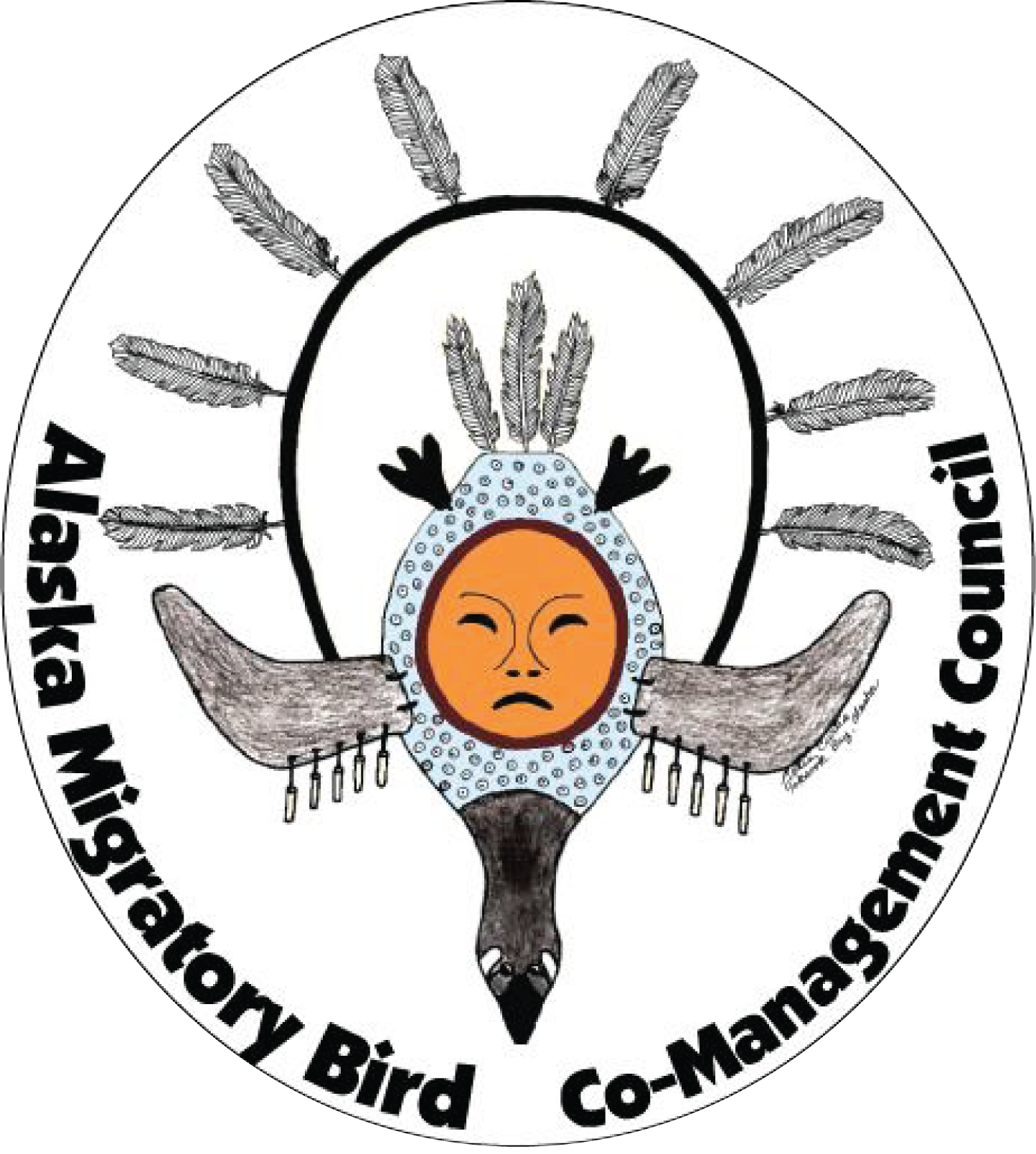
The original drawing is black and white; the colors used here were added in 2009 when new outreach materials were produced for the AMBCC subsistence harvest survey.
The choice of colors was based on historical and current Yup’ik artwork. Katie Curtis was consulted during this process and agreed with the use of the colors. The mask depicts a Canada goose surrounded by 8 feathers.
The feathers represent the 8 steps to implement a legal, regulated spring subsistence bird hunt:
1) Notify people of the intent to form management bodies;
2) Meet to share ideas;
3) Send out ideas and listen;
4) Choose the form of management bodies;
5) Start rule-making;
6) Recommend rules for Alaska;
7) Link with management in other U.S. flyways; and
8) Link with the nation.
Since its inception, this new regulatory framework has been designed to promote true collaboration among a diversity of stakeholders as cultures intermingle in the history of wildlife management and conservation in Alaska.
AMBCC Executive Committee
-
![Patty Schwalenberg that AMBCC Executive Director]()
Patty Schwalenberg
Executive Director
AMBCC Office
6450 Andover Cir
Anchorage, Alaska 99516 -
![graphic flat lay image of the shape of alaska representing the Alaska Native Caucus for now]()
Randy Mayo
AMBCC Executive Committee Member
Alaska Native Caucus Chair & Tanana Chiefs Conference
(Interior Region)
P.O. Box 74319
Fairbanks, Alaska 99707
Ph. (907) 978-1670
Email randyamayo@gmail.com -
![U.S. Fish & Wildlife Service Badge Logo]()
Wendy Loya
AMBCC Executive Committee Member
U.S. Fish and Wildlife Service
Division of Migratory Bird Management
1011 E. Tudor Road
Anchorage, Alaska 99503
Ph. (907) 786-3375
Fax (907) 786-3641
Email wendy_loya@fws.gov -
![Alaska Department of Fish and Game Logo]()
Ryan Scott
AMBCC Executive Committee Member
Alaska Department of Fish and Game
Assistant Director of Division of Wildlife Conservation
P.O. Box 115526
Juneau, Alaska 99811
Ph. (907) 465-4191
Email ryan.scott@alaska.gov

Partners Technical Staff
-
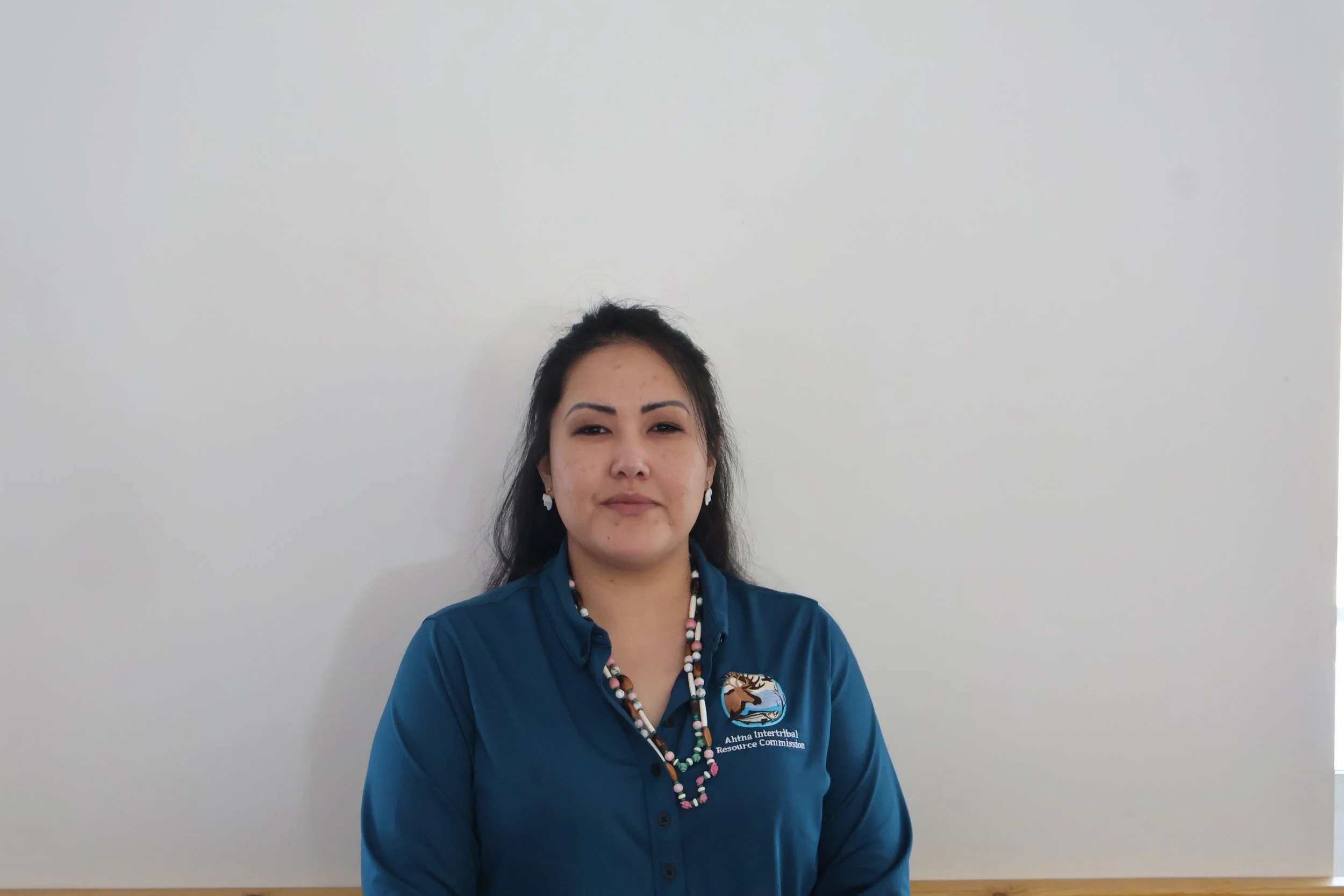
![Deanna Kosbruk Regulations Specialist and tribal historic preservation officer for Ahtna Intertribal Resource Commission]()
Deanna Kosbruk
Regulations Specialist/Tribal Historic Preservation Officer
Ahtna Intertribal Resource Commission
Email deanna@ahtnatribal.org
-
![Greg Russell Southwest Subsistence Resource Specialist 3 from Alaska Department of Fish and Game, Division of Subsistence]()
Greg Russell
Southwest Subsistence Resource Specialist 3
Alaska Department of Fish and Game, Division of Subsistence
Email greg.russell@alaska.gov

Common Questions Answered
-
No. Migratory birds are not managed under ANILCA. Management of migratory birds is through the migratory bird treaties between the United States of America, Canada, Japan, Great Britain, and Mexico.
-
In the early 1900's, migratory bird hunting in North America was not Federally regulated and commercial market hunting of birds took its toll on population numbers.
The 1916 Migratory Bird Treaty with Canada sought to stem the rapid declines noted in some bird species.
The treaty prevented market hunting, opened regulated sport hunting of “game” species (primarily waterfowl), and protected birds during the nesting season, March 10 through September 1.
Similar migratory bird treaties were subsequently signed between the United States and Mexico (1936), Japan (1972), and Russia (1976).
To implement these treaties in the United States, Congress passed the Migratory Bird Treaty Act (1918 with later amendments).
-
The traditional harvest of migratory birds by northern peoples during the spring and summer months was not taken fully into account during the legal negotiations for the treaties with Canada and Mexico.
This harvest, which had occurred for centuries, was necessary to the subsistence way of life in the north and thus continued despite the closed season.
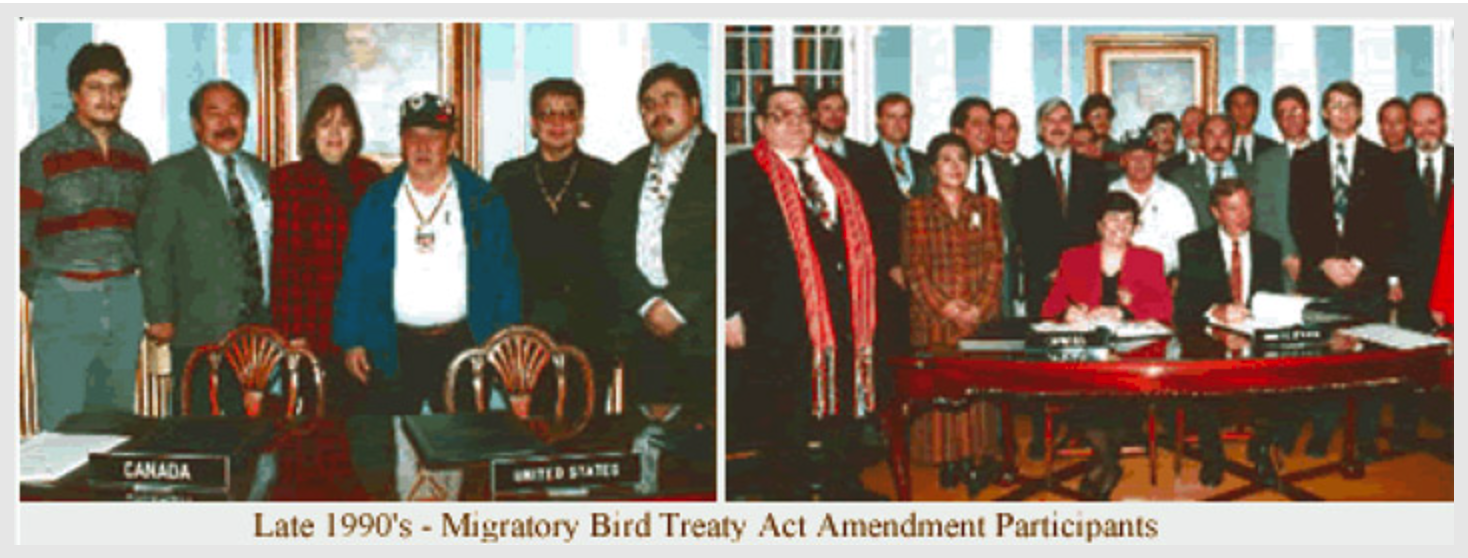
To remedy this situation, the United States negotiated Protocols amending both the Canadian and Mexican treaties to allow for spring/summer subsistence harvest of migratory birds by indigenous inhabitants of identified subsistence harvest areas in Alaska.
The U.S. Senate ratified the amendments to both treaties in 1997.
-
The amended treaty with Canada calls for creation of management bodies to ensure an effective and meaningful role for Alaska’s indigenous inhabitants in the conservation of migratory birds.
AMBCC was created as a statewide body to develop, implement, and promote a co-management program between Alaska Native, Federal and State governments in recognition of the subsistence use and conservation of migratory birds in Alaska, as part of the national migratory bird conservation system.
According to the Letter of Submittal, management bodies are to include Alaska Native, Federal, and State of Alaska representatives as equals.
-
The AMBCC is 13 member council comprised of one Federal representative designated by the Alaska Regional Director of the U.S. Fish & Wildlife Service, one State representative designated by the Commissioner of the Alaska Department of Fish & Game, and eleven representatives from the Alaska Native non-profit partners. Each faction is entitled to one vote.
-
1. To ensure the conservation of migratory birds; and to perpetuate the continuation of the customary and traditional harvest of migratory birds by indigenous inhabitants;
2. To promote the co-management of migratory birds;
3. To develop recommendations for spring and summer subsistence seasons, methods, means and bag limits which are consistent with the customary and traditional uses of migratory birds and their eggs by Alaska’s indigenous inhabitants;
4. To recommend law enforcement policies and to assist in their implementation;
5. To develop cooperative programs to monitor migratory bird populations and harvests;
6. To promote, recommend and assist in migratory bird research and incorporate traditional ecological knowledge in migratory bird research projects;
7. To promote and recommend habitat protection policies;
8. To provide education and information to the public, appropriate management agencies, and other interested parties;
9. To provide guidelines within which the regional bodies can recommend harvest regulations and conservation measures, and;
10. To coordinate with other migratory bird groups, joint ventures, and teams regarding issues of common concern.
-
No, the regulations voted on at the AMBCC are not final.
The AMBCC is part of a larger system of both national and international migratory bird management. The council will provide advice, recommendations and information regarding subsistence use and the conservation of migratory birds in Alaska.
The Council recommendations are forwarded to the Service Regulations Committee who acts on them and makes the final recommendations to the Secretary of the Interior.em description
-
There is a fall meeting that is held for the primary purpose of providing background information and guidelines to the regions to develop regulatory and other recommendations for migratory birds.
A spring meeting is held prior to the Flyway Council meetings to review and vote on regulatory recommendations that are forwarded to the AMBCC by each of the regions or the public. The Council will accept public comment on all regulatory and non-regulatory matters prior to any vote. The council package is sent to the four flyway councils to maintain communications and cooperation between the flyways. The package is ultimately sent to the Service Regulations Committee for their action during the meeting to act on late season proposals.
State-Wide Public Meetings
Attend our public meetings to be be in-the-know of regulatory & non-regulatory matters.
-
The annual statewide Spring meeting allows Council members the opportunity to consider and take action on any proposed migratory bird regulatory proposals that have been submitted during the open proposal period (November 1-December 15 annually).
Other business during this meeting may include the sharing of time-sensitive information relevant to the upcoming spring-summer harvest season for that year.
-
The annual statewide Fall meeting focuses on sharing new information and environmental observations from the Native Caucus, hearing technical reports on migratory bird research from the partner organizations, discussing any ideas for new regulations or amendments to existing regulations, and learning the latest results from the summer aerial and ground-based population surveys.
Reference Library
Stay updated & informed with Past State-Wide Public Meeting Transcripts, Treaties, & Historical Documents that affect Alaskan Migratory Bird Subsistence, Native Handicraft Regs, & more.
Do The Regulations Affect You?
Our Overview Page offers summaries of:
What the Reg Book is for.
Legislative History.
Definitions.
Use & Possession.
Eligibility.
Special Requirements.
& Required Licensing or Stamps.
